The Hook Is Not Always the Chorus
Find a song’s memorable hook with a focused listening routine that separates its lyric, rhythm and instrumental phrases from the chorus.

You hear a new song while washing up, then catch yourself repeating a clipped guitar phrase long after the chorus has passed. That phrase may be the hook. To identify a song hook, listen for the detail that stays with you, not just the section with the biggest vocal or the most repeated words.
A chorus is a structural section; a hook is a memorable musical idea. A song may have several hooks, and one can appear in a verse, an instrumental break or a backing vocal. A hook might be a line of lyric, a rhythmic turn, a melody or a particular sound. The aim of this week-long listening routine is to hear those parts separately, then work out what gives one of them staying power.
Start by listening without naming the hook
On the first day, choose one song you know well and play it once without pausing. Keep a notebook nearby, but do not write during the song. Afterwards, jot down the first sound, word or rhythm that comes to mind. Add where it appeared: for example, “two-note keyboard after the second verse”.
This first impression is useful precisely because it is rough. If you decide in advance that the chorus must be the hook, you can overlook a small phrase that makes the song distinctive. Record what your attention actually retained, even if it seems slight.
Write the song title and your first impression before listening again.
Track where the memorable phrase appears
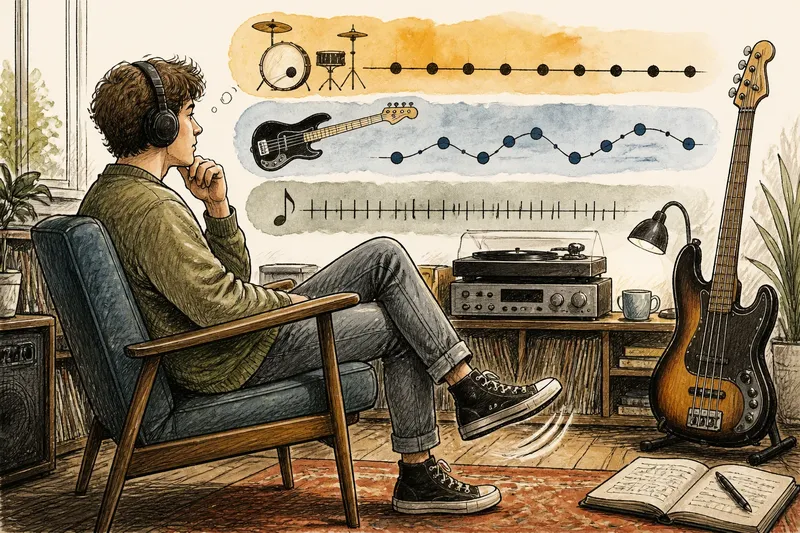
On the second day, listen once more and mark each return of the phrase you noted. You can use a simple timeline in your notebook: verse, chorus, transition, instrumental passage, outro. No specialist software is needed. If you prefer a visual aid, place a few markers along a line and label them as the sections pass.
Pay attention to whether the phrase repeats exactly or changes. A singer might use the same words with a different melody; a guitar figure might return under several different lyric lines. A sound can also be memorable because it appears only once, at a moment when the arrangement leaves space around it.
Say you hear a short whistle after each verse, while the chorus has a familiar repeated refrain. Note both. The whistle may be the part you recall first, while the refrain remains the main structural landmark.
Separate the lyric, rhythm and instrumental hook
On the third day, focus on the words. Listen for a phrase with an unusual image, a crisp rhyme, a repeated name or a line whose natural speech rhythm stands out. Then ask whether the words remain memorable when you imagine them spoken without music. If they do, the lyric may be carrying much of the hook; if not, its melody or delivery may be doing more work.
On the fourth day, ignore the meaning of the words and listen for rhythm. Notice a syncopated syllable, a pause before a word, a repeated handclap or a vocal phrase that lands just ahead of the beat. Tap quietly or mark the pattern with short strokes in your notes. The memorable feature may be the way a phrase moves, rather than the notes or words alone.
On the fifth day, listen for instrumental and vocal sounds around the lead. A bass figure, a bright keyboard answer, a backing-vocal harmony or a brief guitar bend can all function as hooks. Try to identify the sound by its role and character rather than guessing the exact instrument: “high, sliding response after the vocal” is a useful description.
Test what makes a song hook memorable
On the sixth day, replay the song and compare your notes. For each possible hook, ask what helps it stick: repetition, a clear contour, a distinctive rhythm, a striking sound, a pause that frames it, or a change that makes it stand out. Several features may combine. A lyric can be ordinary on the page but memorable because the singer stretches its final vowel over a rising melody.
Then listen to a different song, preferably one with an obvious chorus. Note whether your attention lands on the chorus line, an instrumental motif or a rhythmic detail elsewhere. This comparison helps separate the hook from the section label without treating either as more important.
Which part of a song is the hook?
Can a verse contain the main hook?
Yes. A verse can introduce a recurring melody, phrase or instrumental figure that listeners remember more readily than the chorus. Its position in the song does not determine whether it works as a hook.
Can a hook have no words?
Yes. A short instrumental phrase, a distinctive drum accent or a backing-vocal sound can be memorable without a lyric. Describe its shape, timing and sound to make it easier to recognise on another listen.
Can a song have more than one hook?
Yes. A vocal refrain may be the most obvious hook, while a recurring instrumental response supplies another. Different listeners may latch onto different details, and one listener’s attention can shift over time.
How is a hook different from a chorus?
A chorus is a section of a song, often returning with related words and music. A hook is a memorable idea that can sit inside that section or appear elsewhere.
Describe the hook without relying on a label
On the seventh day, write a brief listening note using concrete details: where the phrase occurs, what it sounds like, what repeats and what changes. Avoid stopping at “catchy chorus”. Try “the clipped three-note keyboard answer returns after each sung line” or “the singer pauses before repeating the final word”. Those descriptions help you hear the arrangement rather than simply naming a section.
If you are making music, this method can also guide a small creative decision. Say you have a verse lyric that feels memorable but a chorus that blurs into the surrounding sections. You could sing the lyric in a few different rhythmic shapes, then listen back and note which version is easiest to recall. The point is not to make every song depend on one trick; it is to notice which musical detail is already drawing attention.
For a song hook, keep the main search phrase in mind while listening: ask which detail returns to your thoughts after playback, then check where it sits and what carries it. That question gives you a practical description of the hook, even when the chorus is not the part you remember.
Keep your notes for another song later in the week. Comparing the phrases you remember across different arrangements can sharpen your ear for hooks that whisper, answer, interrupt or repeat.