Before the Album: Songs and the Rise of the Long-Playing Record
Learn how the long-playing record emerged, how it differed from earlier formats and why its longer playing time helped albums take shape.
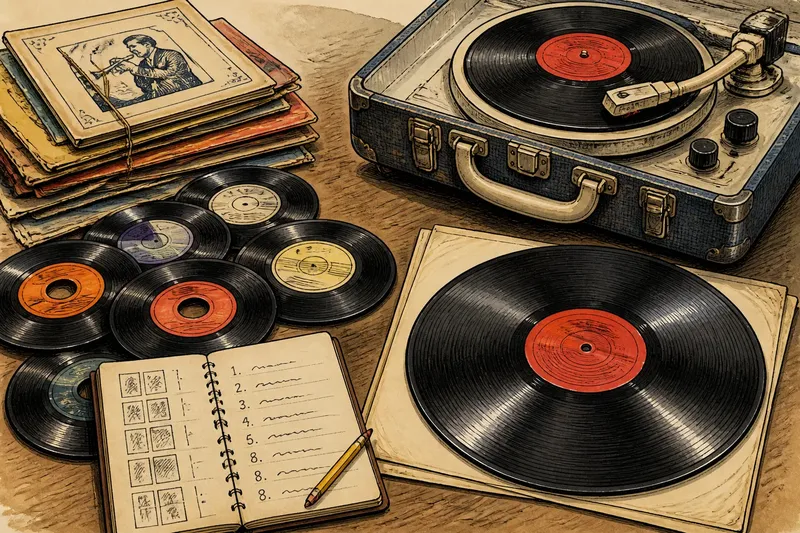
At a record shop, a listener choosing a stack of short-play discs had to think about how many records to carry home. The long-playing record changed that practical calculation: it could hold a longer programme on each side, making the album a more workable format for presenting several songs together.
The long-playing record did not invent the idea of grouping music. Before it arrived, labels issued collections and listeners assembled songs on multiple discs. Its importance lies in the format’s longer playing time and its influence on how record companies could package music, rather than in a sudden change to every artist’s approach.
Earlier records set limits on how music was sold
Before the LP became established, commercial recordings commonly appeared on discs that held only a short programme on each side. A collection of several songs could therefore require multiple discs, gathered in a bound album or sold as a set. The word “album” already described a collection; the LP did not create it.
Those earlier formats suited individual songs and short groups of recordings. But changing discs interrupted playback, and a substantial collection took up more physical space. The limits shaped how music could be issued and handled, though they did not prevent musicians or listeners from thinking about songs as a group.
Keep the distinction clear: collections existed before the LP, while the LP made longer collections easier to issue on fewer discs.
The LP combined longer playing time with a new disc format
In the late 1940s, record companies introduced competing long-playing microgroove records. Columbia’s LP, launched in 1948, became a prominent example. Its fine groove and slower rotation allowed more recorded music on a disc than the common short-play formats of the period. RCA Victor introduced its competing 45-rpm record in 1949, designed chiefly for individual songs.
The LP and the 45 served different purposes in the market. The compact 45 suited a single, while the LP offered room for a longer programme. Neither format immediately displaced the other. For a time, labels issued music across formats, and the choice depended on the kind of release and the audience it was intended to reach.
That contrast helps explain the LP’s rise: it was not simply a larger version of a single. It gave labels another practical option for presenting a collection of performances under one release.
Longer sides made the album a more practical release
With more playing time on each side, an LP could gather several songs without requiring a separate disc for each short recording. This did not mean every release became a carefully unified artistic statement. Labels could use the format for collections, performances or programmes of songs, and the purpose varied from release to release.
For artists and record companies, the LP offered room to present more material together. That possibility encouraged some releases to be planned as albums, but it did not dictate a single method of writing or recording. Some records gathered songs around a shared idea; others brought together performances without an explicit narrative.
Say a label has an invented set of eight short songs previously issued across several discs. By preparing them for an LP, it can present the tracks as one release with a front and a back side. The observable result is a more compact physical package and a continuous programme on each side, not proof that the songs were written as a story.
The album’s identity developed through several influences
The LP’s longer capacity helped the album become a more prominent unit of release, but the format alone did not create album-centred listening. Record-company decisions, recording technology, performers’ ambitions and listeners’ habits all contributed. Their influence differed across genres and periods, so the shift was gradual rather than uniform.
Packaging also helped make a collection legible as a single object. A sleeve could display a title, artwork and track list; printed credits could identify performers and writers. These features gave listeners information and a point of recognition, but they did not determine how a record should be interpreted.
For historical context, treat the LP as an enabling format: it made longer releases easier to produce and handle, while artists, labels and listeners decided what to do with that capacity.
How did the LP change record releases?
Did albums exist before the LP?
Yes. Collections of recordings were issued before the LP, including sets gathered in album-like bindings. The LP changed the practical format by fitting a longer programme onto fewer discs.
Why did labels use both LPs and 45s?
The formats served different release needs: the 45 was suited to individual songs, while the LP accommodated a longer programme. Labels could use either, or both, depending on the material and their release plans.
Did the LP immediately replace earlier records?
No. Formats overlapped, and established records remained in use while LPs gained a place in the market. The transition varied by label, audience and type of music.
Did every LP present a unified artistic statement?
No. An LP could contain a deliberately connected programme, but it could also gather songs or performances without a single theme. The format offered capacity; it did not prescribe artistic intent.
The LP changed what a release could contain
The long-playing record gave labels a practical way to put a longer programme on one disc, while its arrival sat alongside older formats rather than erasing them at once. Collections had existed before it; the LP made the album a more convenient and visible form for presenting several recordings together.
When comparing an LP with an earlier set of discs, look first at the release date, the format and the track list. That simple check separates the history of the technology from assumptions about what the music meant to its makers.