Bass Line or Drum Pattern: What Carries the Pulse?
Learn how to tell whether bass or drums carry a track’s pulse, and how to listen past fills, accents and other parts layered around the beat.
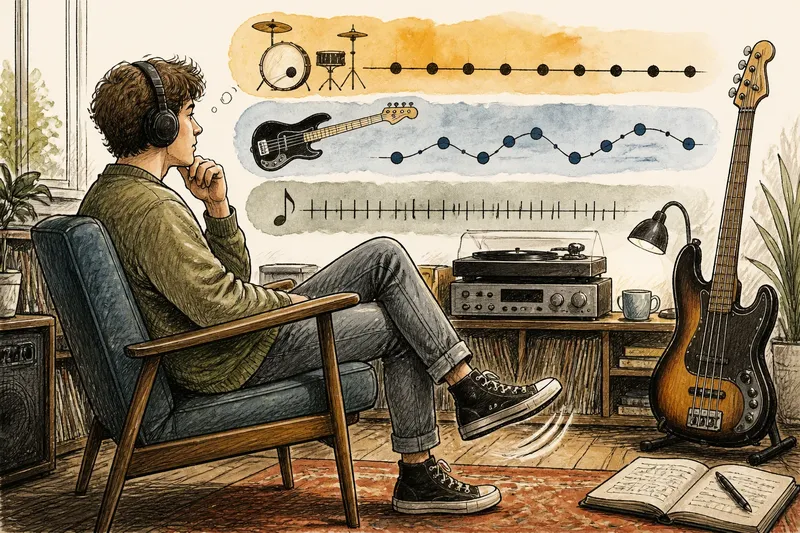
Put on a track with a steady kick drum and a wandering bass line, and tap your foot without thinking about it. Now listen to a section where the drums drop out: if your tap keeps going, the pulse may be carried by bass, another instrument, or the song’s internal regularity rather than by the drum pattern alone. To tell what carries the pulse, separate the underlying beat from the sounds that mark, decorate or pull against it.
What does it mean for a part to carry the pulse?
The pulse is the regular sequence of beats you can tap, step or nod along to. It is the track’s basic sense of forward motion, not necessarily a sound that appears on every beat. A bass note or drum hit can make the pulse easy to hear, but the pulse itself is the listener’s sense of an ongoing beat.
Several layers can help establish it at once. The kick may mark a low point, the snare may emphasise a backbeat, and the bass may connect one beat to the next with a repeated figure. A guitar strum, keyboard chord or vocal phrasing can reinforce the same motion, even if none of those parts plays every beat.
It helps to distinguish three jobs. A part can mark the beat with clear attacks, imply it through a repeating pattern, or add movement that sits around it. The same instrument can switch jobs from one section to another. A drum fill may briefly draw attention away from the beat, while a sustained bass note can hold a pitch without clearly marking each pulse.
Can bass carry a pulse without a strong drum pattern?
Yes. A bass line can carry the pulse when its notes arrive in a regular, memorable pattern, particularly when their attacks line up with the beats or create a dependable recurring figure. Repeated notes, alternating notes and a consistent pattern of long and short sounds can all make the beat feel clear without a prominent kick or snare.
Listen for the start of each bass note, not only for its low pitch. The attack tells you when a new event begins; the note’s tail tells you how long the sound continues. A held note may give a phrase weight while leaving the precise beat less obvious. A sequence of short notes can make the pulse easier to follow, even if it does not land on every beat.
Bass can also imply a pulse through repetition rather than a one-note-per-beat pattern. If a phrase returns in the same place and has a stable shape, your ear may anticipate its next arrival. That anticipation can keep the music moving during a sparse passage. It is still useful to ask whether you are tapping the beat or following the bass phrase’s rhythm, since the two do not always match.
Can drums carry a pulse when the bass line moves freely?
Yes. A steady kick, hi-hat, ride cymbal or hand percussion pattern can make the pulse plain while the bass plays syncopated notes, long tones or a melody that crosses the beat. In that arrangement, the drums provide a regular reference point and the bass supplies motion around it.
Not every drum sound has the same role. A repeated hi-hat can mark small, even subdivisions, while the kick may emphasise selected beats and the snare may give the pattern a familiar accent. A cymbal crash or busy fill can be prominent without carrying the ongoing pulse. Loudness and importance are not the same as rhythmic function.
Try tapping to the most regular drum layer, then notice how the bass relates to your tap. If bass notes arrive between your taps, they may be syncopated rather than out of time. That contrast can make a groove feel buoyant or unsettled while the pulse remains stable underneath.
How can you tell which part carries the pulse?
Use a short, focused listen rather than trying to name every instrument at once. Pick a section with a clear groove, keep a steady tap, and compare your tap with the bass attacks and the drum accents. Then listen again through a transition or a brief drop in the arrangement, where one layer may become easier to hear.
- Choose a stable passage. Avoid an opening, breakdown or fill at first; use a section where the rhythm has settled.
- Tap the beat you hear. Keep your tapping simple, without trying to follow every quick note.
- Follow the bass attacks. Notice which taps align with new bass notes and which notes fall between taps.
- Follow one drum layer. Listen separately for kick, snare, hi-hat or another repeating percussion sound.
- Compare the layers. Ask which one makes the beat easiest to predict, and which one adds syncopation, subdivision or accents.
- Listen through a change. If a layer drops out, keep tapping and observe whether the pulse stays clear or becomes harder to place.
Say you hear a track with a steady closed hi-hat, a kick that skips some beats, and a bass figure that repeats with a note between two of your taps. You could keep time most easily from the hi-hat, while recognising that the bass figure gives the groove its distinctive push. That is a useful distinction: the part that marks the pulse most clearly need not be the part that makes the rhythm most memorable.
What should you listen for when the parts disagree?
When bass and drums stress different moments, look for the recurring beat beneath their accents. A bass note may arrive just before a drum hit, or a snare may emphasise a beat that the bass leaves open. These choices can create tension, lift or a sense of looseness without changing the underlying tempo.
Pay attention to repetition. If the drum pattern keeps a regular cycle while the bass varies its notes, the drums may be the clearest pulse cue. If the percussion is sparse but a bass figure returns predictably, bass may take the lead. If both parts are intermittent, another repeated sound or the phrasing of the whole arrangement may support your sense of time.
Do not assume the lowest sound is bass or that every low hit is a kick drum. A synthesiser, low guitar note or tuned percussion can occupy a similar register. Identify the sound by its pattern and role, not by pitch alone; the important question is when it happens and what it helps you anticipate.
Can the pulse shift between bass and drums?
Yes. A track can change which layer makes the pulse easiest to hear without changing its tempo. In a verse, a regular bass figure may be exposed while percussion stays restrained. In a fuller section, a clear kick and snare pattern may take over as the bass becomes more melodic or syncopated.
The change may also be temporary. A drum fill can blur the regular pattern for a moment, while a sustained bass note or repeated chord keeps the passage grounded. When the fill ends, the familiar beat becomes clear again. Listen for the layer that remains predictable across the transition, rather than assuming the busiest or loudest sound is in charge.
This shifting emphasis is one reason the question has no answer that applies to every track. Bass and percussion can share the work, trade it between sections or leave the pulse implied by other parts. In a focused listen, you are identifying what supports your own sense of the beat at that moment.
How do you avoid confusing pulse with a repeating riff?
A riff is a musical figure that returns; a pulse is the regular beat against which figures can be placed. A riff may span several beats, begin off the beat or include uneven note lengths. Its repetition can make it feel like the track’s anchor, but tapping to every riff note may produce a different rhythm from tapping the underlying beat.
To separate them, keep your tap steady while the figure repeats. Notice whether the riff begins at the same point in each cycle and how many taps fit beneath it. If the riff starts between taps, that is a rhythmic placement, not evidence that the pulse has moved. If you lose the tap when the riff changes, listen for another repeating layer before deciding the beat itself has shifted.
What should you focus on first?
Start with whichever layer gives you the clearest, steadiest reference in the passage you are listening to. Follow the bass if its attacks form a dependable pattern; follow percussion if a drum or cymbal keeps time more clearly. Then check how the other layers relate to that reference, including any notes that land between your taps.
For the question “bass line or drum pattern: what carries the pulse?”, the most accurate answer is often “both, in different ways”. One part may make the beat easy to mark, while another shapes its feel through accents, gaps and syncopation. Listen for those separate jobs, and a busy groove becomes easier to hear without flattening it into a single beat.
On your next listen, keep one quiet tap going through a fill or a change in arrangement. That small habit can reveal whether the pulse comes from the bass, the drums, or the relationship between them.